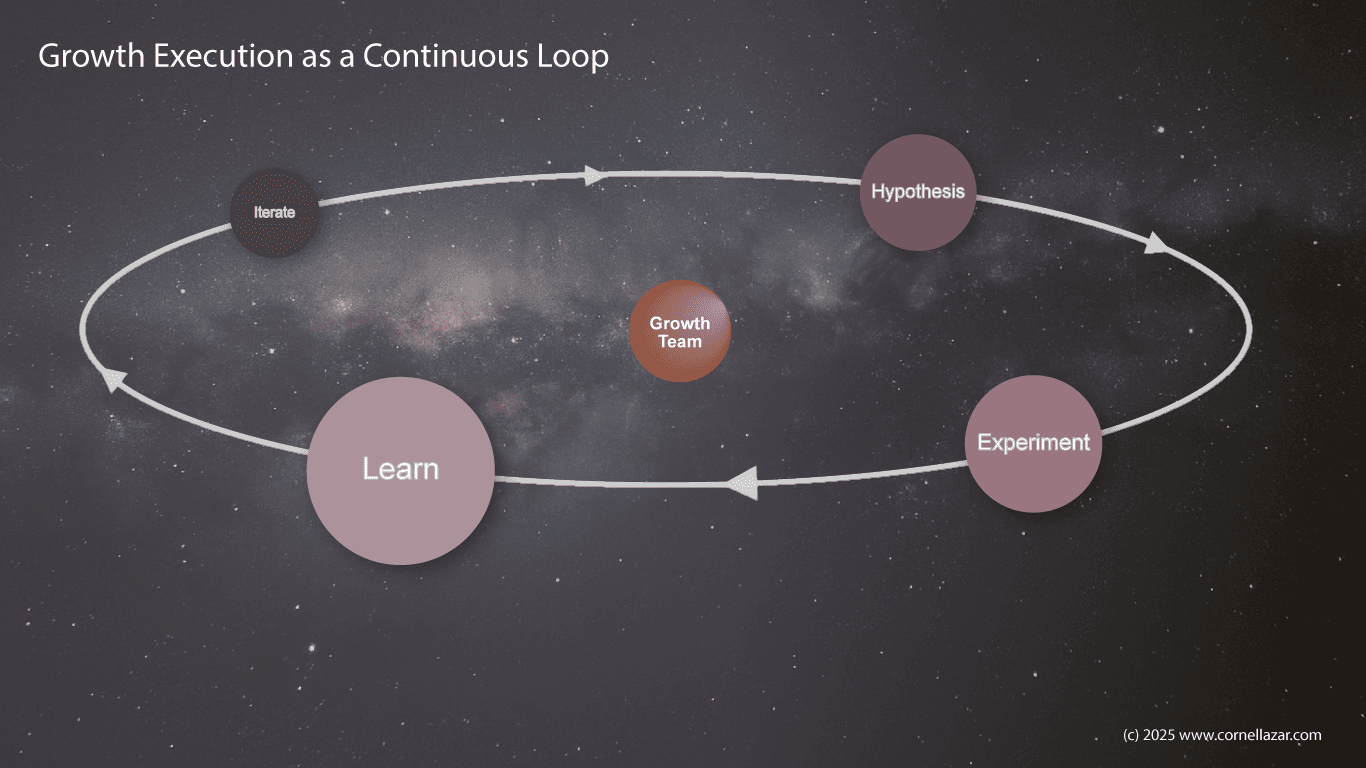

Once organisations move past debating what Growth is, a more practical question follows quickly.
How do you actually compose a Growth team that can operate end-to-end, work across functions, and stay accountable for outcomes rather than activity?
In practice, this is where most friction appears. Not because teams lack talent or intent, but because composition, mandate, and ways of working do not line up. Growth becomes fragmented, execution slows, and optimisation turns local rather than systemic.
The sections below look at how cross-functional Growth teams are typically set up, what responsibilities they carry, and how that structure enables consistent experimentation and impact over time.
This article builds on a broader perspective on what Growth is, what it is not, and why a it requires an E2E mandate. If you have not read it, you can find the first part of the article series here: What Growth Really Is (and Why It Matters).
TL;DR
- Cross-functional Growth teams require clear end-to-end ownership across the funnel.
- Independence enables accountability, not empire building.
- Enablement and innovation sit at the core of the Growth mandate.
- Execution depends on disciplined prioritisation and bottom-up contribution.
- Experiment portfolios must evolve as organisations move from early-stage to maturity.
The role and mandate of a Growth team
An ideal matrix, which rarely exists in its pure form, has the Growth team operating independently, with end-to-end responsibility across the entire funnel and all meaningful touchpoints. From acquisition to retention, and everything in between.
- Taking ownership of product Growth areas such as value propositions, go-to-market strategies, Growth frameworks, and primary KPIs. The focus often sits on onboarding and retention, but not exclusively.
- Operating with data as the primary input. Collect, analyse, test, and repeat.
- Translating business needs and product goals into clear, measurable OKRs.
Enablement & innovation
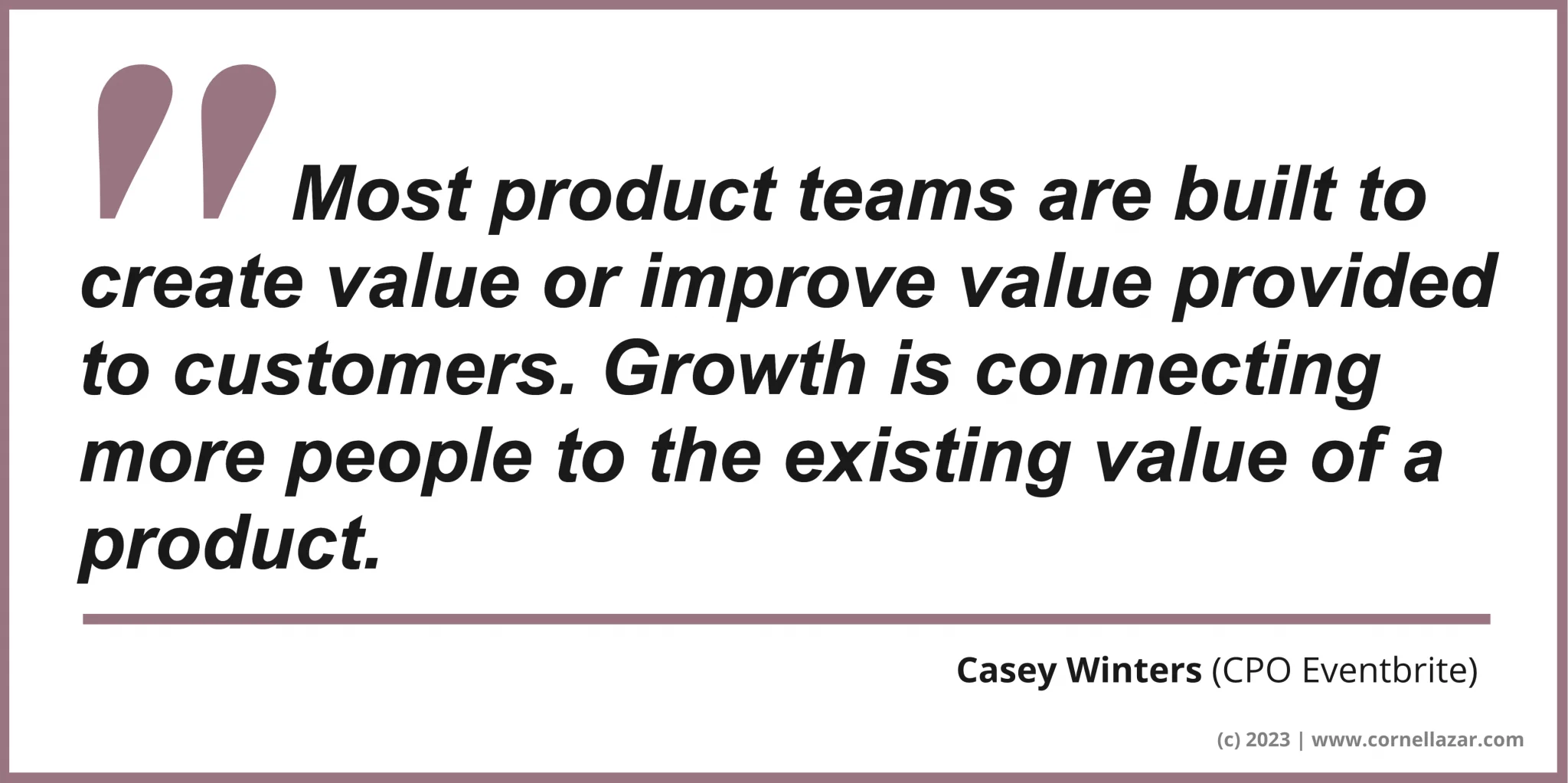
At its core, Growth is about data-informed enablement and innovation across every touchpoint that matters to the user, from acquisition through to retention.
Enablement means constantly seeking to reduce friction across the entire user journey and user experience. The objective is simple. Connect the user with the product and help them experience its value as quickly and clearly as possible.
Innovation means frequently identifying and testing new opportunities and approaches to attract, engage, and convert. This is not about novelty for its own sake, but about systematically expanding what the organisation knows works.
In his book Hacking Growth, Sean Ellis outlines the end-to-end responsibility of a Growth team:
“(Growth teams) should also work on customer activation, meaning making those customers most active users and buyers, and knowing how to turn them into evangelists.
In addition, Growth teams should work on finding ways to retain and monetise customers, that is, both keeping them coming back and increasing the revenue generated from them, in order to sustain long-term growth. So often, too much effort is focused only on acquisition of new users and customers, who then, in so many cases, quickly disengage.”
Structuring your innovation and optimisation roadmap
Given the cross-functional nature of a Growth team and its full-funnel responsibilities, the next question becomes how work is structured into an optimisation and innovation roadmap.
This requires clearly defined objectives and agreed ways of working, supported by shared frameworks.
Growth team structures themselves sit outside the scope of this article. However, the following examples help illustrate why structure and frameworks matter for execution.
- Cross-functional Growth team (Reforge model)
Each function contributes a dedicated resource to the Growth squad.

- Standalone Growth team (Reforge model)
An independent team with members working full-time or brought in based on project needs.

- PLG Growth team (Dropbox model)
A Growth team acting like a sales engine for the core product.

Lever 1: Increase the rigor of your project selection process
‘High Output Management,’ a highly influential book on management by former Intel CEO Andy Grove emphasises the importance of detecting and addressing problems in a production process at the earliest stage possible.
Similarly, in Growth, every experiment carries an opportunity cost. Therefore, it is crucial to adopt a rigorous project selection process that calculates the expected value and estimated return on investment (ROI) for each project.
The formula for calculating expected value is as follows:
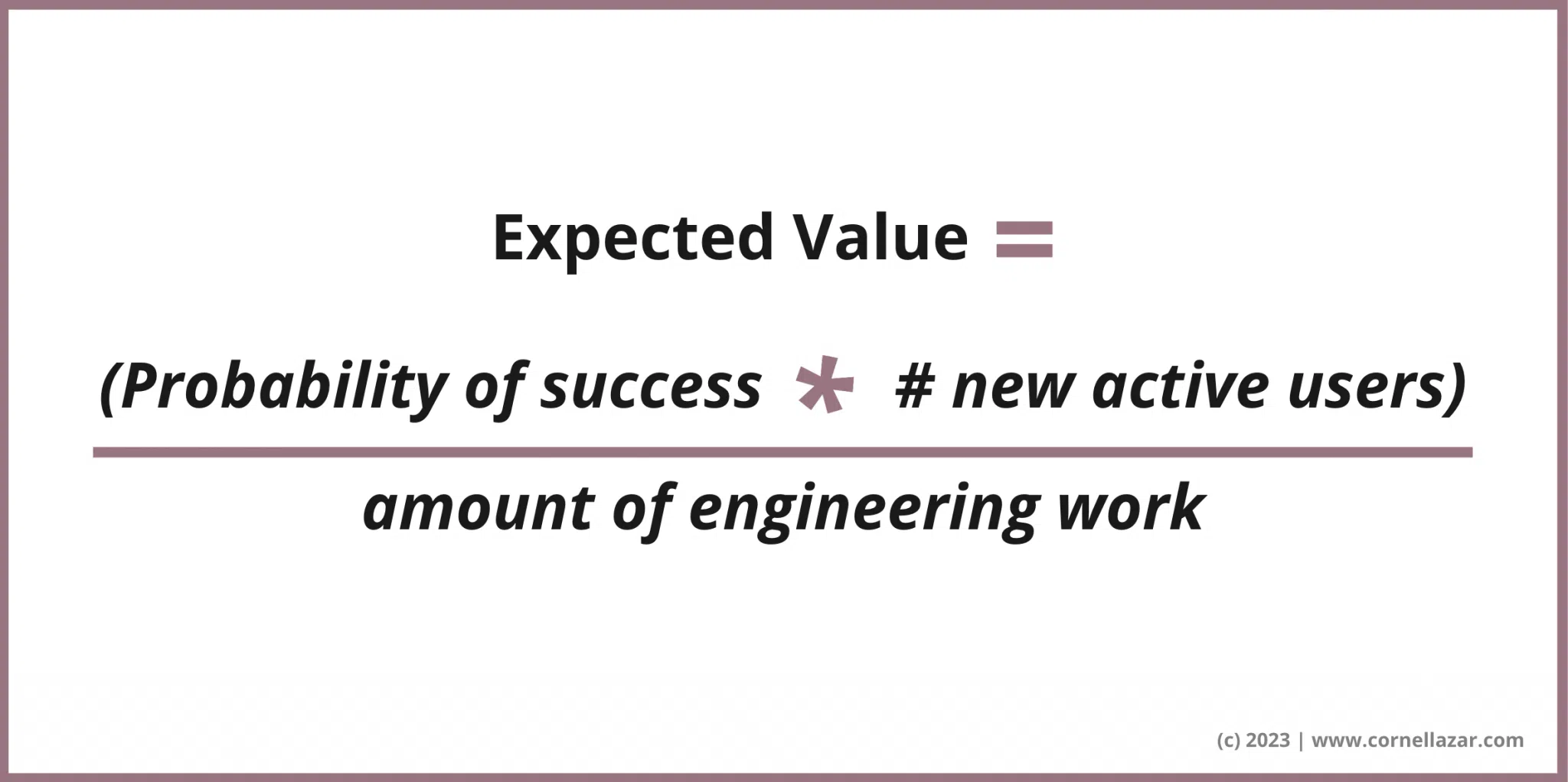
To estimate potential impact, it is useful to start with a clear hypothesis about the metric you aim to improve and model its effect.
For example, if you believe a new email subject line will increase open rates by 5 percent, you can estimate incremental new users by multiplying the number of email clicks, the share of dormant users, and the expected lift.
This type of modelling does not need to be perfect. Its value lies in forcing clarity and trade-offs upfront.
Lever 2: Increase the number of high-quality project ideas
Once a robust project selection process is in place, the next step is expanding the pool of high-quality project ideas.
Rather than relying solely on a Product Manager or Growth Lead, effective teams encourage contribution from across the group. Engineers, designers, and analysts are actively involved in ideation.
This bottom-up approach increases both the quantity and diversity of ideas. With the right training and feedback loops, it also raises idea quality over time.
By leveraging the collective intelligence of the team, Growth backlogs become richer, more varied, and more resilient.
Lever 3: Maximise the impact of every experiment you ship
The third lever focuses on extracting maximum value from every experiment shipped.
Ownership plays a central role here. Engineers and contributors should take responsibility for experiments even when they were not the original idea generators. Ownership means improving the initial concept, proposing variants, and identifying opportunities to increase impact.
With many experiments running in parallel, it is unrealistic for a single person to deeply analyse every initiative. A bottom-up ownership model allows those closest to the work to contribute insights where context is richest.
This approach ensures that opportunities are not left on the table and that learning compounds across iterations.
Evolving your portfolio over time
Maximising returns also requires understanding how experiment portfolios need to change as organisations mature.
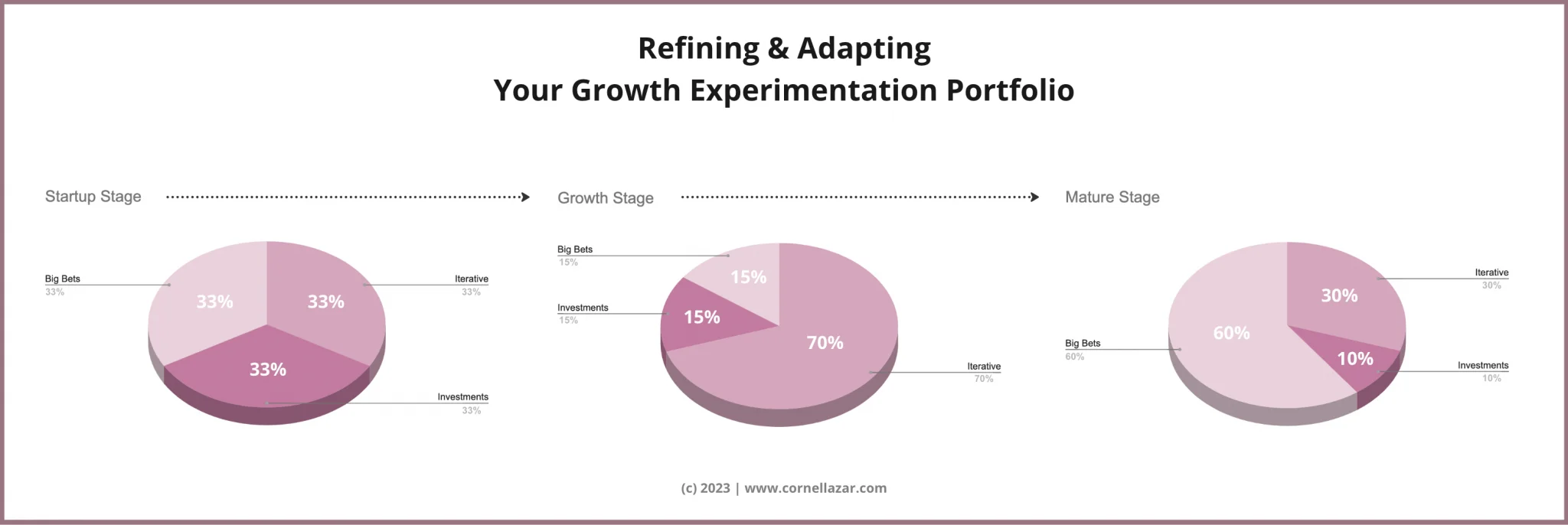
Growth teams typically move through three stages, each requiring a different allocation across project types.
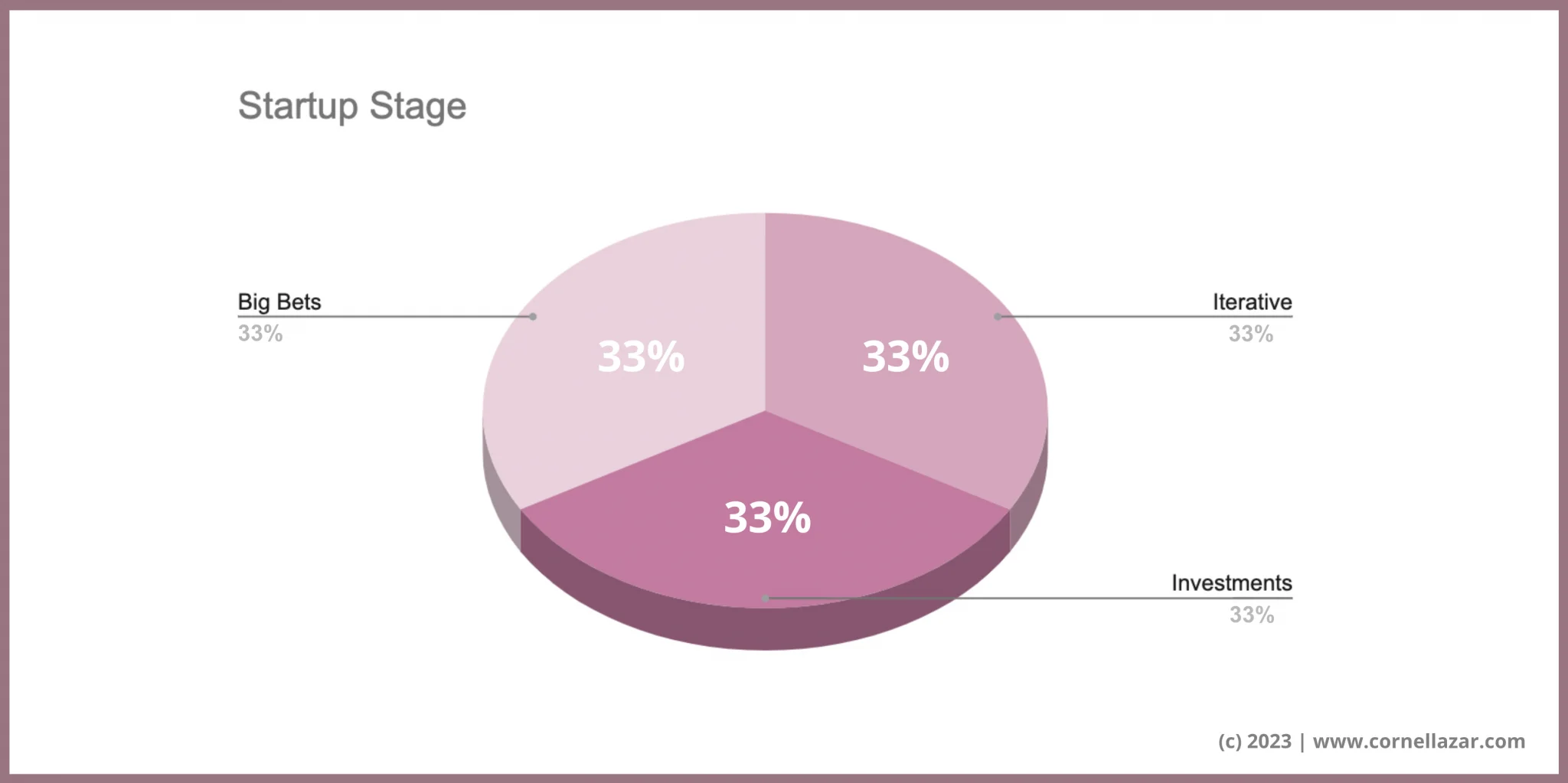
Startup Stage
Early-stage teams face high uncertainty and many unknowns. Foundational elements such as dashboards and experimentation frameworks may still be missing.
A balanced allocation often works best:
- Iterative Experiments (33%):
Focus on securing some early quick wins to demonstrate the team’s ability to drive results and build confidence. - Investments (33%):
Allocate resources to establish essential infrastructure and systems, such as logging pipelines and reports. - Big Bets (33%):
Take calculated risks by exploring untapped areas and experimenting with a few significant initiatives to shape a long-term strategy.
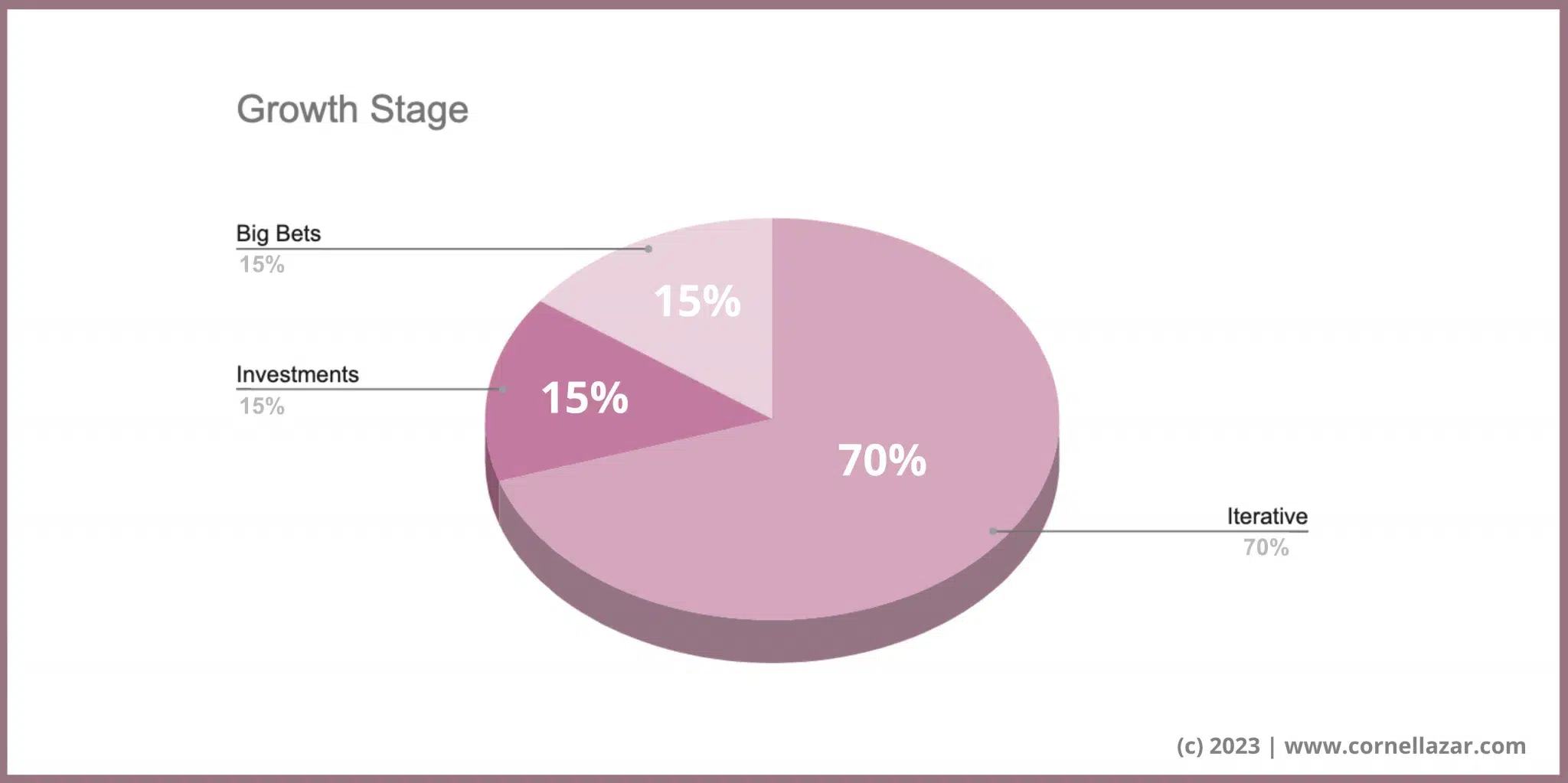
Growth Stage
After gaining traction and understanding what works, the team enters the Growth stage, which can last for several quarters or even years. During this phase, the focus shifts towards iterative experiments and driving impact.
The recommended allocation is as follows:
- Iterative Experiments (70%):
Channel the majority of resources and effort into conducting iterative experiments that have a higher probability of success and impact. - Investments (15%):
Continue making investments to enhance the team’s capabilities for driving long-term impact. - Big Bets (15%):
Pursue some big bets that offer potential for opening up new opportunities in the future.
Mature Stage
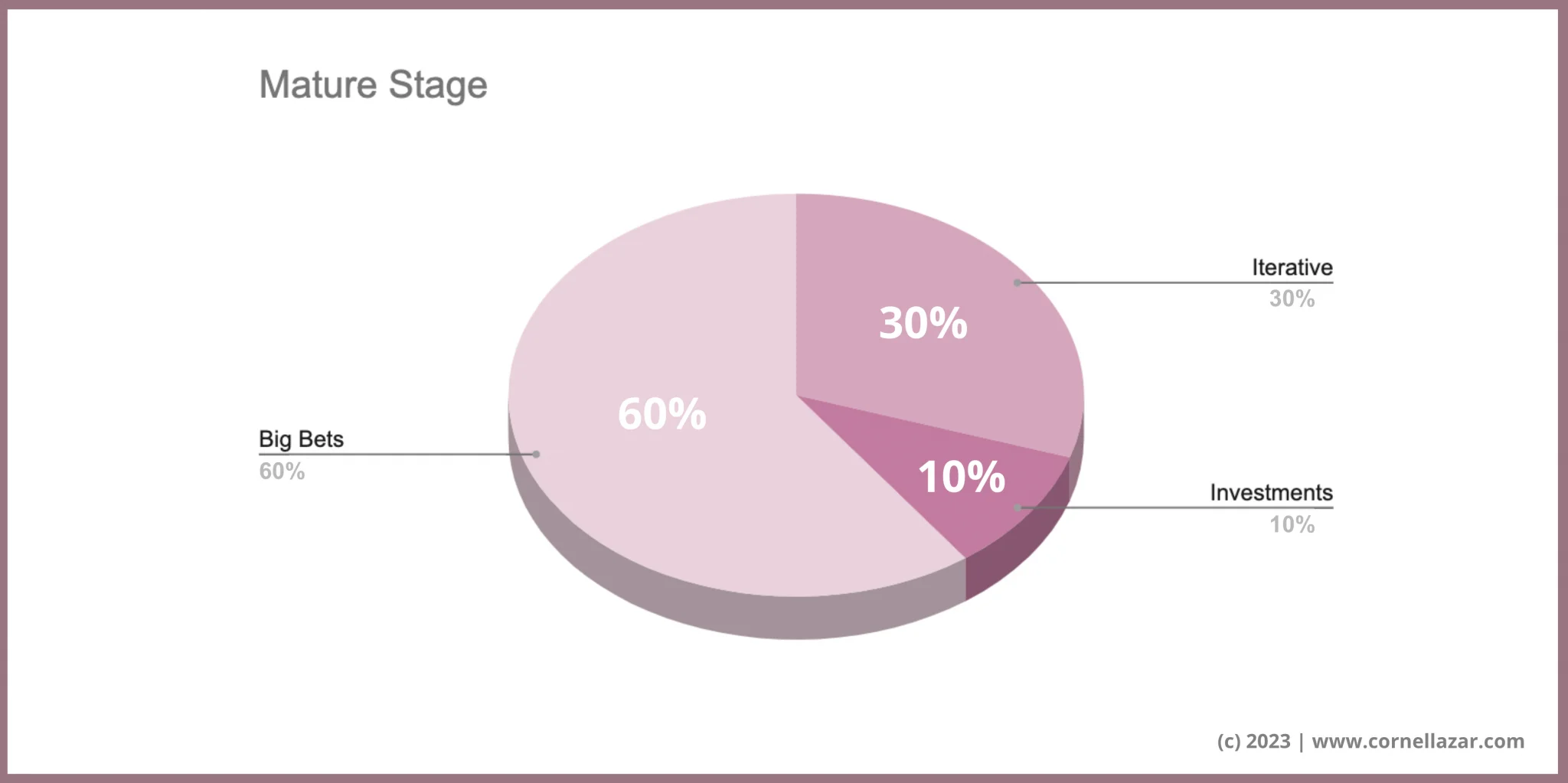
Eventually, a Growth team may reach a mature stage where they have optimised existing strategies and tapped into most available opportunities. At this point, you need to evaluate whether it’s time to pause or break out of the local maxima.
The recommended allocation for the mature stage is as follows:
- Iterative Experiments (30%):
Reduce the time spent on iterative experiments but continue working through the backlog of high-potential ideas. - Investments (10%):
Pause most investment activities unless they are directly tied to the big bets. - Big Bets (60%):
Increase the focus on big bets to explore new areas and disrupt existing strategies. These big bets may require iterative optimisation and a long-term view to surpass the existing control experience.
The composition of a Growth team evolves over time
There is no fixed blueprint for a Growth team.
What works at one stage often becomes a constraint at another. Teams that treat Growth as a static setup tend to optimise what already exists until progress slows.
Teams that regularly revisit composition, portfolio mix, and ways of working give themselves room to break out of local maxima and explore new growth curves.
Growth does not succeed because a team exists. It succeeds when that team is allowed to evolve and remain accountable for outcomes rather than activity.
Read next: What is Growth - and what it is not
Execution only works when the mandate is clear. In this article I look at what Growth actually is, what it is not, and why Growth needs full E2E ownership. This article is part of a series of articles on Growth.
Read next: What Growth Really Is (and Why It Matters)